

Table of Contents
There’s no single “best” air compressor that suits every job, every site and every budget, and anyone telling you otherwise is probably trying to sell you the one model they happen to stock. The right compressor depends on your power source, how continuously you’ll be running it, the tools you’re powering, and the conditions you’re working in, whether that’s a suburban workshop or a remote regional site with no mains power at all. Crommelins Machinery has been supplying generators, pumps and air compressors to Australian tradespeople and households since 1958, and this guide walks through how to work out which compressor actually earns the “best” label for your specific situation.
"Best" Depends on Your Application
Before comparing specific models, it’s worth being honest about what you actually need the compressor to do. A compressor that’s genuinely the best choice for occasional nail gun use around the house would be a poor, underpowered choice for a tradesperson running spray equipment all day, and a heavy-duty diesel unit built for site work would be needless overkill for someone who just wants to inflate tyres and run the occasional impact wrench in a home garage. Start with your actual tools and usage pattern, not with a model name, and the right answer becomes much clearer.
Electric Compressors: Best for Workshops with Reliable Power
For a workshop, shed or site with reliable mains power, an electric compressor is generally the simplest and most cost-effective option. Electric units are typically quieter and cheaper to run than petrol or diesel equivalents, and don’t need fuel, oil changes for the engine, or the ongoing maintenance that comes with a combustion engine, making them the lower-hassle choice wherever power is available.
Petrol and Honda-Engine Compressors: Best for Sites Without Power
Where mains power isn’t available, a petrol compressor usually gives you the same capacity and general-purpose usability as the electric model, without needing to run off a generator or extension lead. These suit building sites, outdoor jobs and any location where power access is unreliable or simply not worth the hassle of arranging for a smaller job. The trade-off is the usual one with combustion engines: fuel costs, engine maintenance, and noise levels somewhat higher than an equivalent electric unit.
Diesel Compressors: Best for Heavy, Continuous Site Use
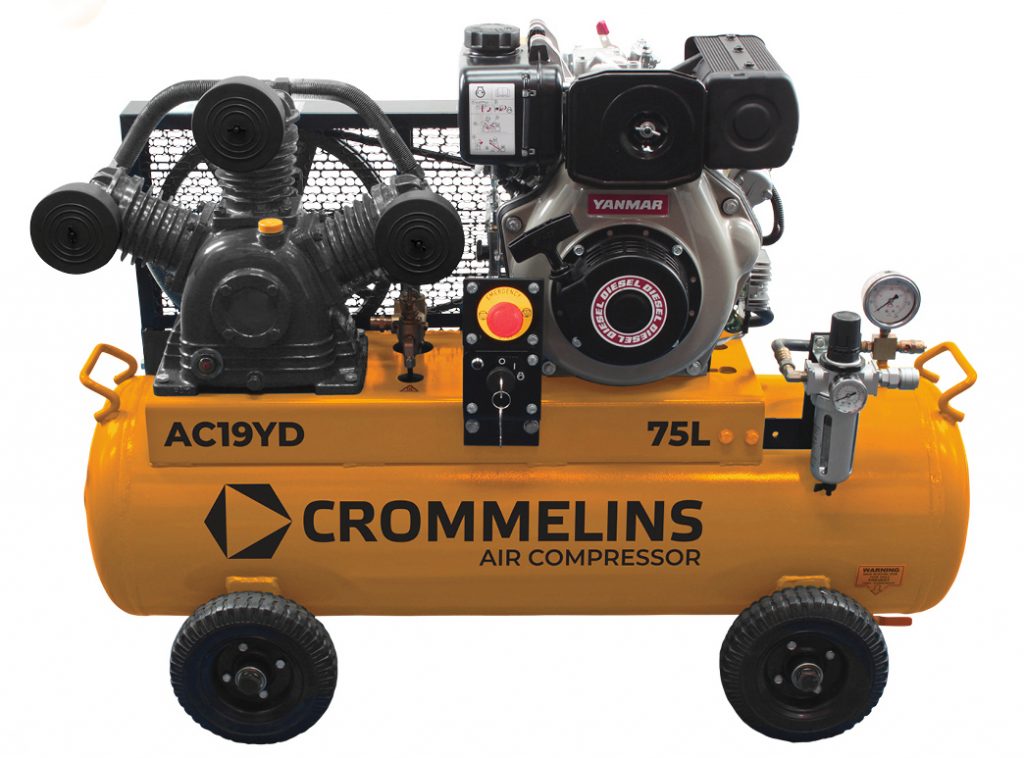
For genuinely heavy-duty or continuous use, Crommelins’ 75 litre diesel compressor, powered by a 4.7hp Yanmar L48N engine, is built for a different tier of demand entirely. Its three-cylinder cast iron pump delivers 540 litres per minute pump displacement (19.1 CFM), with 440 litres per minute free air delivery (15.5 CFM) at a maximum pressure of 1000 kPa (145 psi), suited to industrial, commercial and agricultural applications running air tools, spray equipment, staplers and nailers for extended periods. At 119kg dry weight with 10-inch puncture-proof tyres, a metal belt guard and metal air filter as standard, it’s built to sit on a site and work hard rather than be carried in and out of a ute tray daily. It’s also available with electric start, removing the need to pull-start a diesel engine repeatedly through the day.
Comparing Output: What the Numbers Actually Mean
CFM (cubic feet per minute) is the figure that matters most when comparing compressors, since it tells you how much air the compressor can actually deliver, as opposed to tank size, which only tells you how much is stored at any given moment. The diesel 75 litre unit’s 19.1 CFM pump displacement puts it well ahead of typical smaller electric or petrol units in sustained output, which is exactly why it suits continuous, heavy-demand applications rather than being simply a bigger version of the same thing. When comparing any two compressors, checking CFM at a stated pressure, rather than tank litres alone, gives the more accurate picture of real-world capability.
Noise, Weight and Portability Trade-offs
The diesel 75 litre unit runs at 83 decibels at one metre, noticeably louder than a typical electric compressor, which is a fair trade-off for the sustained output it delivers but worth factoring in for noise-sensitive sites or residential areas. At 119kg, it’s also considerably heavier than electric and petrol models, meaning it’s better suited to staying in one position for a job’s duration than being loaded and unloaded multiple times a day. If portability and quiet running matter more to you than raw sustained output, a lighter electric or petrol range is the more practical “best” choice despite the diesel unit’s higher capability on paper.
Durability Features Worth Checking
Beyond engine type and output, a handful of build details separate a compressor that lasts from one that doesn’t under real site conditions. A metal, rather than plastic, belt guard and air filter housing hold up better to knocks and dust over years of use. Stainless steel valves, like those in Crommelins‘ diesel pump, resist corrosion better than standard steel in humid or coastal conditions common across much of Australia. Puncture-proof tyres matter more than they sound on a compressor that’s regularly wheeled across building sites strewn with offcuts and fasteners, avoiding the annoyance of a flat tyre on a unit that’s otherwise working fine.
Not sure which type suits your load?
Talk to your nearest Crommelins dealer about the best air compressor for your needs, including performance, power requirements and where you’ll be using it across Australia.
Warranty and Support: Part of What Makes a Compressor "Best"
A compressor’s on-paper specifications only tell part of the story; what happens if something goes wrong matters just as much, particularly for trade users who can’t afford extended downtime. Crommelins‘ compressors come with manufacturer warranty backing and support through a nationwide dealer network, meaning parts and servicing aren’t dependent on shipping a unit interstate or waiting weeks for an imported part. When comparing compressors on price alone, it’s worth weighing this kind of ongoing support against a marginally cheaper unit from a brand with limited local backup.
Matching Compressor Type to Trade vs Home Use
Tradespeople running tools continuously across a working day, particularly on sites without reliable power, generally get the most value from the diesel range’s sustained output and durability features, even accounting for the higher upfront cost and greater weight. Home users and light DIY applications, running tools intermittently and usually with power available, are typically far better served by an electric compressor, which delivers everything needed for nail guns, tyre inflation and general workshop tasks at a fraction of the cost and complexity of a diesel unit built for a different job entirely.
Common Mistakes When Choosing "the Best" Compressor
The most common mistake is chasing the highest-output model regardless of actual need, paying more upfront and carrying extra weight and running costs for capability that never gets used. The second most common mistake runs the other way, buying the cheapest or lightest option without checking CFM output against the tools being run, leading to a compressor that can’t keep up under real load. The genuinely best compressor is rarely the biggest or the cheapest; it’s the one whose specifications actually match the job, the power source available, and how continuously it will be worked.
Frequently Asked Questions
What's the best air compressor for a tradesperson?
It depends on the trade and how the compressor will be used. For continuous, heavy-demand work, particularly on sites without reliable power, a diesel compressor like Crommelins‘ 75 litre model offers the sustained output and durability needed. For lighter, intermittent trade work with power available, an electric or petrol unit is often the more practical and cost-effective choice.
Is a diesel air compressor better than an electric one?
Neither is universally better; it depends on your power access and duty cycle. Diesel compressors suit continuous, heavy-duty use and sites without mains power, delivering higher sustained output at the cost of more weight, noise and maintenance. Electric compressors suit lighter, intermittent use where power is available, offering quieter operation and lower running costs for that kind of application.
How much does a good air compressor cost in Australia?
Pricing varies significantly by type and output. A general-purpose electric or petrol compressor sits at a more accessible price point suited to trade and DIY budgets, while a heavier-duty diesel unit built for continuous industrial and commercial use, like Crommelins‘ 75 litre model, represents a larger investment reflecting its higher output, durability features and sustained duty cycle capability.
Find the Right Compressor with Crommelins
The best air compressor is the one that’s genuinely matched to your tools, your power access and how hard you’ll be running it, not necessarily the biggest or most expensive option on the shelf. Crommelins Machinery has supplied air compressors and other portable machinery to Australian trade and home users for more than 65 years, backed by a nationwide dealer network for parts and servicing. Get in touch with your nearest Crommelins dealer to talk through your application and find the compressor that’s genuinely best for you.